TECHNOLOGY · 24 JULY 2026 · 6 MIN READ
How Predictive Maintenance Reduces Downtime and Costs
Discover how Predictive Maintenance, Industrial IoT Solutions, and Intelligent Automation work together to cut downtime and save money.
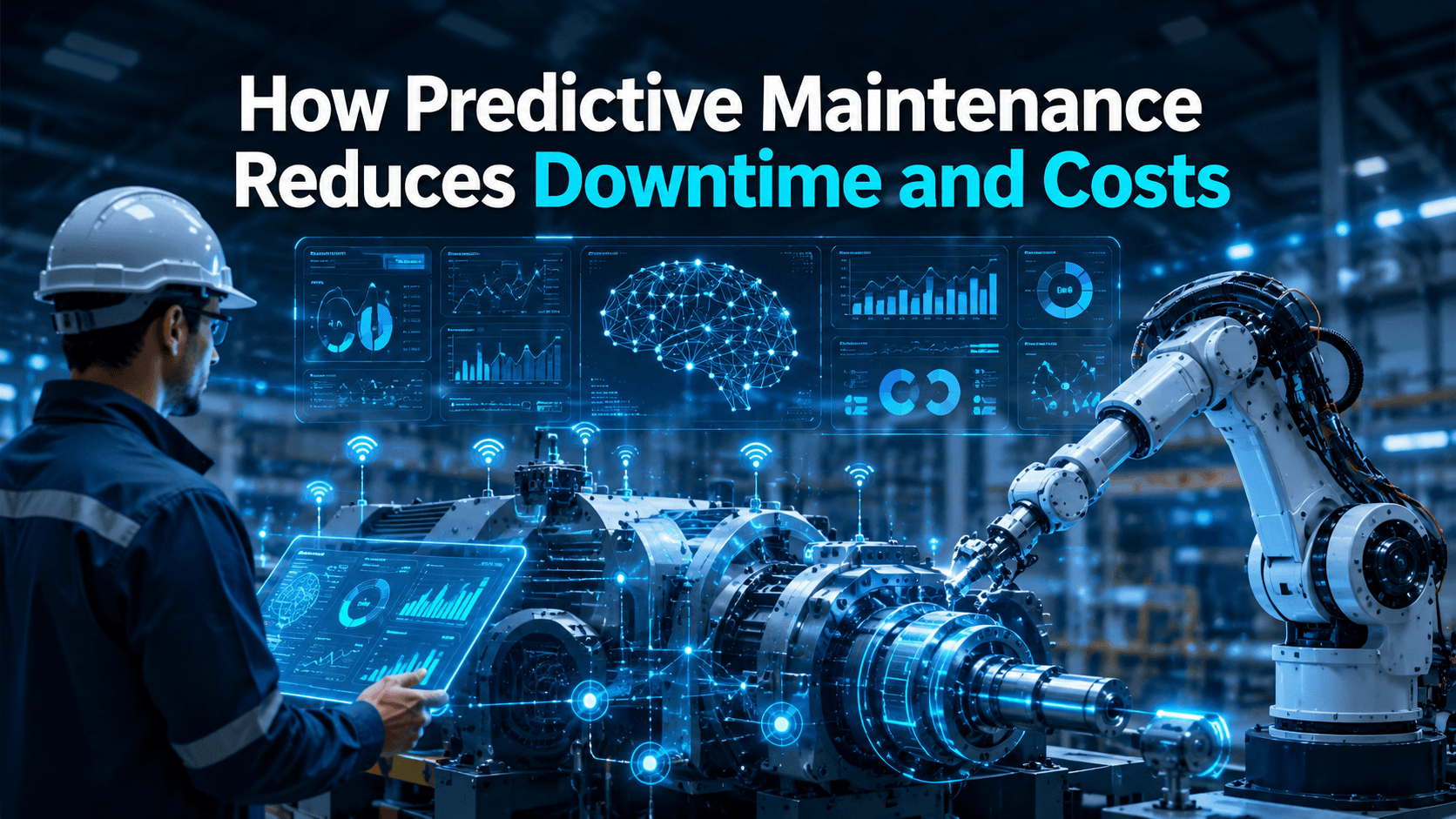
A plant manager once told me something that stuck with me for a while. He said the scariest sound on his factory floor wasn't an alarm — it was silence. Silence meant a machine had already stopped, and by the time anyone figured out why, production had been bleeding money for hours. That's the reality for a lot of factories still running on old maintenance habits. It doesn't have to be, though, and that's really what Predictive Maintenance is solving.
This isn't going to be a dense, technical rundown. We're just going to walk through how predictive maintenance actually works, why it saves real money, and how it ties into Industrial IoT Solutions, working with a good AI Development Company, and Intelligent Automation — all in plain, everyday language.
So What Is Predictive Maintenance, Really?
Here's the simplest way to put it: predictive maintenance uses data to figure out when a machine is probably going to fail, so you can fix it before it actually does. That's different from the two old approaches most factories grew up on — either you wait for something to break (reactive), or you service everything on a fixed calendar whether it needs it or not (preventive). Both waste something. One wastes time, the other wastes money.
Sensors watch machines constantly, picking up on things a person walking by would never notice. A slight rise in vibration. A temperature that's crept up half a degree over two weeks. A sound that's just... a bit off. None of these mean much on their own, but strung together, they're usually an early warning sign, and predictive maintenance systems are built to catch exactly that.
Why Downtime Actually Goes Down
Downtime is sneaky. It doesn't always show up as one big number on a spreadsheet — it hides in delayed shipments, rushed overtime, and customers who quietly start looking elsewhere. Predictive maintenance chips away at all of that in a few practical ways.
Repairs get scheduled during planned downtime instead of during a full-blown crisis. Technicians walk in already knowing what's wrong instead of troubleshooting blind. There's less overtime because fewer emergencies pop up at 2 a.m. And honestly, machines just tend to last longer when they're serviced based on actual condition instead of guesswork. Add all that up and you're not just saving money — you're spending far less time putting out fires in the first place.
Industrial IoT Solutions Make the Data Possible
None of this works without solid data, and that's where Industrial IoT Solutions come in. IoT sensors are the ones actually collecting vibration readings, temperature logs, and performance numbers around the clock. Without connected sensors feeding real information into a central system, predictive maintenance has nothing to work with — it's just guessing with extra steps.
Every machine on the floor essentially becomes a source of live information once IoT is in place. That data doesn't just pile up somewhere either. It flows into analytics platforms where patterns get noticed, often long before a person would ever catch them on their own.
Where an AI Development Company Comes In
Here's the part people often skip over: raw sensor data doesn't predict anything by itself. Someone has to build the intelligence layer that turns numbers into actual warnings, and that's usually where partnering with an experienced AI Development Company pays off.
AI teams train models on historical data to learn what "normal" looks like for a specific piece of equipment, then flag anything that starts drifting away from that baseline. A good AI development company will build models trained on your actual machines instead of forcing your data into some generic template, keep improving accuracy as more data rolls in, plug predictions directly into the tools your team already uses, and build dashboards simple enough that non-technical staff can actually read them without a training session.
Without that layer, all your sensor data is really just noise. AI is what makes it useful.
Intelligent Automation Closes the Loop
This is where things get genuinely efficient. Intelligent Automation takes whatever predictive maintenance flags and turns it into action — without a human needing to manually respond every single time.
Say a system predicts a bearing is likely to fail in the next couple of weeks. Intelligent automation can automatically create a maintenance ticket, trigger a parts order, or even adjust machine settings to ease the strain until someone gets to it. That closes the gap between "we noticed a problem" and "the problem is already being handled," which honestly is where a lot of the real time savings come from.
What Businesses Actually Notice
When Predictive Maintenance, Industrial IoT Solutions, a solid AI Development Company's models, and Intelligent Automation all work together, the results tend to show up fairly quickly — fewer surprise shutdowns, lower repair bills, equipment that lasts longer, better safety on the floor, and operations that just feel less chaotic day to day.
These aren't one-off wins, either. Stretched over a year, the combined savings from avoided downtime and smarter scheduling can be significant, especially for operations running expensive or critical machinery.
Starting Small Without Overcomplicating It
You really don't need to overhaul the whole facility at once. Pick one critical machine, add sensors, let it run for a few weeks to establish a baseline, then bring in predictive maintenance tools once you know what "normal" looks like. From there, an AI development company can help scale predictions across more equipment, and intelligent automation can gradually take over the routine response work.
Frequently Asked Questions
1. What is predictive maintenance in simple terms?
It's using sensor data to predict when a machine will likely fail, so repairs happen before a breakdown occurs.
2. How does predictive maintenance lower costs?
It reduces emergency repairs, cuts downtime, and helps equipment last longer through timely servicing.
3. Why do I need Industrial IoT Solutions for predictive maintenance?
IoT sensors are what collect the real-time data predictive maintenance systems need to work accurately.
4. What does an AI Development Company actually do here?
They build and train the models that analyze sensor data and predict equipment failures accurately.
5. How is intelligent automation different from predictive maintenance?
Predictive maintenance identifies the problem, while intelligent automation can automatically act on it, like scheduling repairs.
Final Thoughts
Downtime and surprise repair bills don't have to just be "part of the business." With Predictive Maintenance backed by solid Industrial IoT Solutions, guided by a capable AI Development Company, and supported by Intelligent Automation, operations can shift from constantly reacting to actually staying ahead of problems.
Want to reduce downtime and cut maintenance costs?
Reach out to a trusted AI development team today and start building an operation that fixes problems before they cost you anything.

Elisha Ruth
Content Writer & Digital Marketing Specialist
Elisha Ruth is a passionate content creator with expertise in SEO, blogging, and brand storytelling. She believes in crafting content that connects with people and delivers measurable results.
Published on 24 July 2026
Want to talk through a system like this?
Tell us what you're building. We'll respond within two business days.
Talk to engineeringUP NEXT