TECHNOLOGY · 22 JULY 2026 · 6 MIN READ
Industrial IoT Solutions: A Beginner's Guide to Smart Operations
Learn how Industrial IoT Solutions, predictive maintenance, and AI engineering services help factories run smarter, safer, and cheaper.
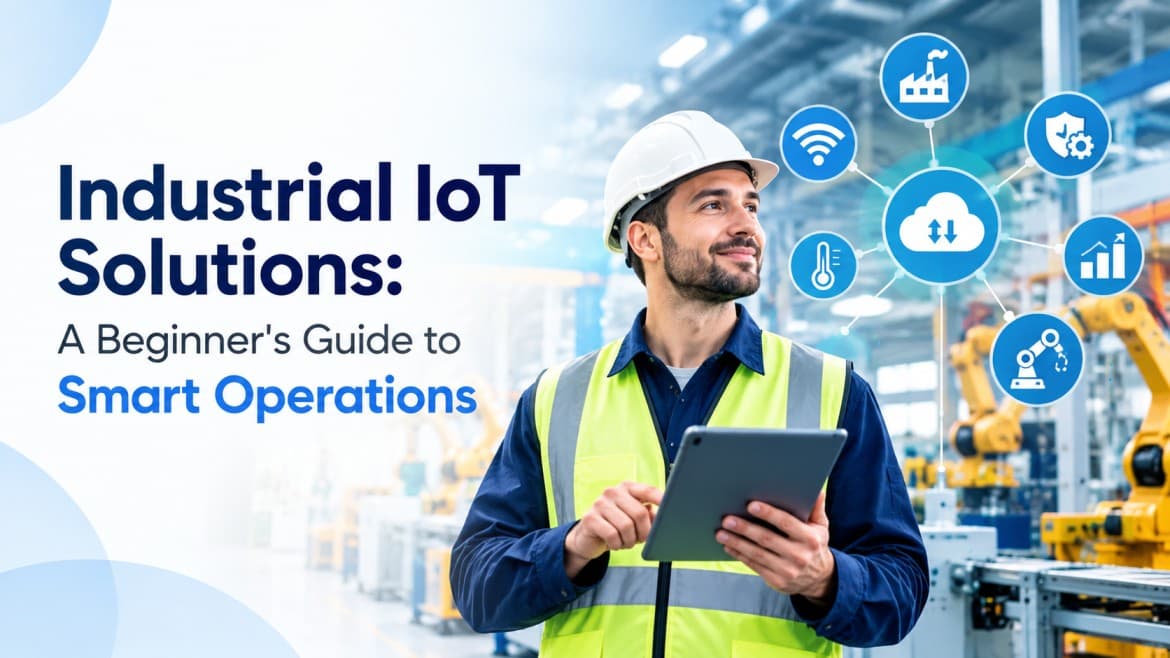
I still remember visiting a manufacturing plant a few years back and being genuinely surprised by how "quiet" the chaos was. No one was running around waiting for something to break. Instead, a technician was casually glancing at a screen that had already flagged a motor showing early signs of trouble — days before it would have actually failed. That's Industrial IoT Solutions in action, and honestly, it's one of those technologies that sounds complicated until someone explains it in plain terms.
So let's do exactly that. No heavy jargon here. Just a straightforward look at what Industrial IoT actually is, why predictive maintenance is such a big deal, and how AI Engineering Services tie the whole thing together into something factories can actually use.
What Is Industrial IoT, Really?
Strip away the buzzwords and Industrial IoT (people usually just say IIoT) is really about one thing: connecting machines and sensors so they can talk to each other and to us. Temperature, vibration, pressure, energy use, run-time — all of it gets captured and sent somewhere useful, usually a dashboard or a cloud platform where someone (or some algorithm) can actually do something with it.
Think about how factories used to operate. Something breaks, someone notices, someone gets called, and production stops until it's fixed. That's reactive maintenance, and it's expensive in ways that don't always show up right away — lost hours, rushed repairs, frustrated customers waiting on shipments. Industrial IoT Solutions flip that whole model. Instead of reacting, you start anticipating. And once manufacturing, logistics, energy, and oil and gas companies realized what that shift could save them, adoption took off pretty fast.
Predictive Maintenance: Where Things Get Interesting
Here's the part that tends to get people excited once they understand it. Predictive maintenance does exactly what its name suggests — it predicts when a machine is likely to fail, often weeks in advance, instead of waiting for the breakdown to happen.
Sensors keep an eye on things constantly. A slight increase in vibration, a subtle temperature shift, an unusual sound pattern — these little signals show up long before an actual failure. Predictive maintenance systems pick up on them and give your team a heads-up while there's still time to act.
Why does this matter so much in practice?
· Downtime is brutal on the bottom line. Every stopped minute costs money.
· Emergency repairs almost always cost more than planned ones.
· Machines that get serviced at the right time — not too soon, not too late — simply last longer.
· Catching faulty equipment early also means fewer safety incidents on the floor.
It's really that simple. You stop firefighting and start preventing fires in the first place.
So Where Does AI Engineering Come In?
Here's the thing nobody tells you upfront — collecting data is the easy part. Thousands of sensors pumping out numbers every second is useless unless something (or someone) can actually interpret what it all means. That's the job of AI Engineering Services.
AI engineers build the smart layer sitting on top of all that raw IoT data. They train models to understand what "normal" looks like for a specific machine, then flag anything that drifts away from that baseline. And these models don't stay static — they keep learning, getting sharper as they see more of your equipment's actual behavior over time.
A solid AI engineering team usually helps with things like:
· Designing custom models instead of forcing your data into a generic, off-the-shelf tool
· Plugging AI directly into the systems your plant already uses
· Turning complicated data into dashboards a non-technical manager can actually read
· Scaling everything smoothly as more sensors and machines get added down the line
Put simply, IoT gathers the raw information, and AI engineering is what turns that information into decisions people can act on. Neither one does much good without the other.
What Businesses Are Actually Getting Out of This
It's one thing to talk about the theory, but what does this look like in real numbers and real operations? Companies that combine Industrial IoT Solutions with predictive maintenance and proper AI engineering tend to report a fairly consistent set of wins — fewer surprise breakdowns, lower repair bills, smarter energy use, safer working conditions, and equipment that simply runs more efficiently day to day.
None of these are minor. For a mid-sized or large operation, that combination often adds up to real, measurable savings within the very first year of implementation.
How to Actually Get Started
You don't need to rip out your entire operation and start over. That's not how this works, and honestly, most successful rollouts start pretty small.
1. Pick one machine or process that matters most, and start there.
2. Add sensors and hook them up to a simple IoT platform.
3. Let it run for a few weeks so you can learn what "normal" actually looks like.
4. Layer in predictive maintenance tools once you have a baseline.
5. Bring in experienced AI engineering services to help you scale beyond that first machine.
Small, steady steps like this keep the project manageable while still showing real value early on — which matters a lot when you're trying to get buy-in from the rest of the team.
Frequently Asked Questions
1. What is Industrial IoT in simple words?
It's the practice of connecting factory machines and sensors so they can share real-time data and help teams run things more efficiently.
2. How does predictive maintenance actually save money?
By catching problems early, which means fewer emergency repairs and a lot less unplanned downtime.
3. Do small businesses really need Industrial IoT Solutions?
Yes — even a small operation can benefit from lower repair costs and fewer surprise breakdowns.
4. What exactly do AI engineering services do in this setup?
They take the raw data IoT sensors collect and turn it into useful predictions and insights people can act on.
5. Is Industrial IoT expensive to set up?
Not necessarily. Most businesses start with just one machine or process and expand from there.
Final Thoughts
Industrial IoT Solutions have stopped being a "someday" technology and quietly became the standard for how modern plants and factories operate. Pair connected sensors with predictive maintenance and the right AI engineering services, and you end up with something genuinely powerful — an operation that catches problems before they cost you anything.
Whether you're running one production line or managing an entire facility, this is a good time to start exploring what these tools could actually do for you.
Ready to make your operations smarter?
Reach out to an experienced Industrial IoT and AI engineering team today and take the first real step toward predictive, efficient, future-ready operations.

Elisha Ruth
Content Writer & Digital Marketing Specialist
Elisha Ruth is a passionate content creator with expertise in SEO, blogging, and brand storytelling. She believes in crafting content that connects with people and delivers measurable results.
Published on 22 July 2026
Want to talk through a system like this?
Tell us what you're building. We'll respond within two business days.
Talk to engineeringUP NEXT